

Free installation + 2-year warranty on every purifier · Installation and service across Mangaluru, Bengaluru and nearby towns · Book a lab test
What size water softener does your home need? A Mangaluru sizing guide
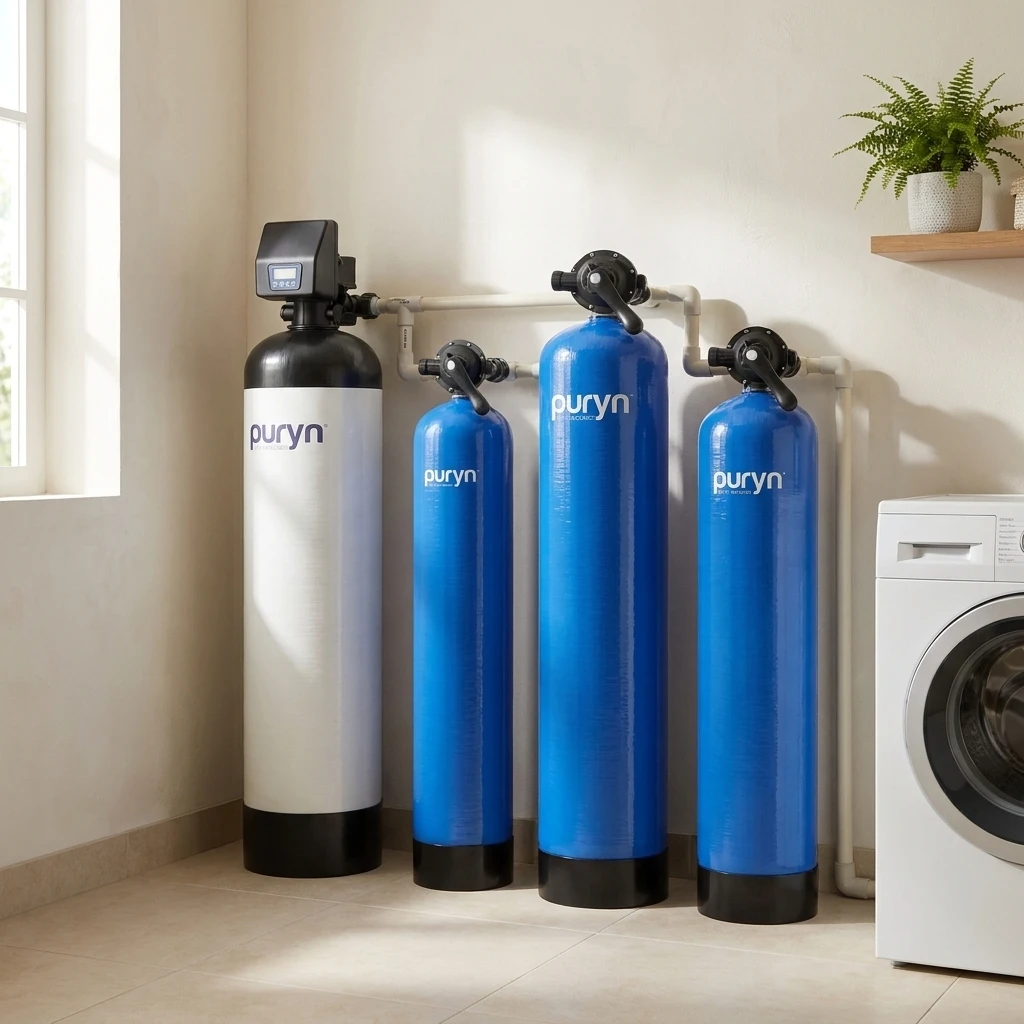
Two numbers decide which water softener your home needs, and they are not the same number. Flow rate (rated in LPH) decides whether the softener keeps up when two taps run at once. Capacity decides how many days you get before it needs regenerating. Buy on flow alone and you will regenerate every second day. Buy on capacity alone and your shower pressure drops. Here is how to size both.
First: do you actually need a softener?
A softener is a plumbing-level fix for hard water, not a drinking-water treatment. It removes calcium and magnesium, the two minerals that scale your geyser, block shower heads, leave white spots on utensils and make soap refuse to lather.
The Indian standard IS 10500:2012 puts the acceptable limit for total hardness at 200 mg/L as CaCO₃, with 600 mg/L as the outer permissible limit when no alternative source exists. Below 200 you generally do not need a softener. Between 200 and 400 you will see scale and stiff laundry. Above 400 the damage to geysers and washing machines is fast and expensive. The only way to know your figure is to measure it.
How much water does your household actually use?
Indian planning norms are a good starting point. BIS set 135 litres per person per day (LPCD) for domestic supply, adopted by CPHEEO for cities with piped water and sewerage, rising to 150 LPCD for metros and dropping to 55 LPCD as the rural benchmark under the Jal Jeevan Mission.
Here is the part most people find surprising: of that 135 litres, CPHEEO assumes only about 6% goes to drinking and cooking. The other 94% is bathing, laundry, cleaning and flushing. That is exactly the water a softener is for, and it is why a purifier and a softener are not alternatives to each other. One treats the six percent you drink. The other treats the ninety-four percent that touches your skin, your clothes and your appliances.
For a family of four in Mangaluru, plan on roughly 540 litres a day (4 × 135).
Sizing number one: flow rate (LPH)
LPH means litres per hour. Convert it to litres per minute and it becomes intuitive: 1000 LPH is about 16.7 litres a minute. A typical shower draws 8 to 10 litres a minute, a tap 4 to 6.
So a 1000 LPH unit comfortably covers one shower and a tap together. It does not comfortably cover two showers plus a washing machine at 7 am. Size flow to your peak simultaneous demand, not your average, because undersizing here shows up as pressure loss exactly when everyone is getting ready.
| Rated flow | Roughly equals | Typical fit |
|---|---|---|
| 1000 LPH | 16.7 L/min | 1–2 bathroom flat, outlets used one at a time |
| 2000 LPH | 33 L/min | 2–3 bathrooms with some overlap |
| 3000 LPH | 50 L/min | Larger home, simultaneous use across floors |
| 6000–9000 LPH | 100–150 L/min | Apartment blocks, hotels, commercial laundry |
Sizing number two: capacity, and how often you regenerate
Capacity comes from the resin inside the vessel. Standard softening resin exchanges roughly 55 grams of hardness (as CaCO₃) per litre of resin before it is exhausted and needs regenerating with salt.
That gives a simple formula:
Litres of soft water per regeneration = (resin litres × 55 × 1000) ÷ hardness in mg/L
Work it through for a real Mangaluru case. Take a 25 litre resin softener and water at 300 mg/L hardness, which is common on borewell supply here. Capacity is 25 × 55 = 1,375 grams of hardness. Divide by 300 mg/L and you get about 4,580 litres of soft water between regenerations. At 540 litres a day, that is roughly eight and a half days per regeneration.
Now double the hardness to 600 mg/L and the same softener gives only 2,290 litres, about four days. This is the single most important thing to understand about softeners: your hardness does not change the size of the machine you need, it changes how often you feed it salt. Two identical homes with different bore water will have very different running costs.
What regeneration costs you
Regeneration uses common salt, roughly 150 grams of NaCl per litre of resin. The 25 litre example needs about 3.75 kg of salt each time. At eight-and-a-half-day intervals that is around three regenerations a month, so roughly 11 kg of salt monthly. Good resin lasts three to five years before it needs replacing.
Manual softeners are cheaper to buy and you start the regeneration cycle yourself. Automatic units do it on a timer or meter without anyone remembering. If your regeneration interval works out to once a week or less, manual is genuinely fine. If your water is hard enough to need it every two or three days, automatic pays for itself in avoided forgetfulness.
Common questions
Can I drink softened water?
A softener swaps calcium and magnesium for sodium, so softened water carries more sodium than the water going in and does not remove bacteria, nitrate or dissolved solids. Soften the house supply, and treat drinking water separately with a purifier matched to your test results.
Will a softener reduce my TDS?
No. It exchanges one set of ions for another, so total dissolved solids stay broadly the same. If your problem is high TDS or a salty taste, you need RO, not softening.
Does a softener help with iron in borewell water?
Only slightly, and it comes at a cost. Iron fouls softening resin and shortens its life. Where water is staining sinks orange, an iron removal stage belongs before the softener, not instead of it.
Is a bigger softener always better?
No. An oversized unit costs more, holds more resin than you use, and if it sits too long between regenerations the resin bed can channel and lose efficiency. Size it to your measured hardness and real peak flow.
Get the two numbers before you buy
Everything above needs your actual hardness figure and an honest count of how many outlets run together in your house. Puryn measures both across Mangaluru and Surathkal, then sizes the unit against your numbers rather than a generic chart. If your hardness comes in under 200 mg/L we will tell you that you do not need a softener at all.
Sources: Bureau of Indian Standards, IS 10500:2012 Drinking Water Specification; CPHEEO Manual on Water Supply and Treatment and BIS per-capita norms (135 LPCD domestic, 150 LPCD metro, 55 LPCD rural under Jal Jeevan Mission); standard ion-exchange resin capacity and regeneration salt dosage per water-treatment design references.
Not sure about sizing? Book a lab test and we will size the softener on-site, honestly.
Keep reading


Not sure what your water needs? Get it lab-tested.
TDS, pH, hardness and iron – measured at your doorstep in Mangaluru and across our 50 km service area, with an honest recommendation based on the numbers.